
Product scaling without losing momentum (or your mind)
A few weeks ago, I had a Digital Native subscriber reach out with a question:
“I’m swamped with updating my product while juggling endless customer requests, and the product’s growing faster than I can keep up. I’m thinking of bringing in more hands to help but worried it’ll just mean more back and forth and less action. Any tips on scaling a business without dropping the ball?”
I’ve heard this from product builders before. I went through similar growing pains when I was trying to scale the creative agency I founded, 45royale.
Here are the three most important things I’ve learned about product scaling without losing momentum (or your mind.)
The art of strategic hiring
Scaling a business means you’ll have to hire at some point. And if you haven’t experienced the pain of a bad hire, you will someday. Trust me, it’s something you carry with you forever.
That’s why I always tell digital business owners that cultural fit is the most important thing to consider when hiring your first one or two people.
If you’ve worked solo for a while, it’s hard to understand the impact another person can have on your business, for better or worse. Bringing someone into the core of your small product or service business can be highly disruptive if not done with care.
Here are a few things I look for when making a hire:
- Look for a self-starter. Someone who can take a problem and move it forward with little to no instruction. Testing, implementing, evaluating the outcome. That’s half the battle in any fast-paced digital business, and your new hire should embrace it completely.
- Find someone who’s highly motivated and thrives on aligned incentives, whether that’s compensation, autonomy, or growth opportunities. You want a person who isn’t just driven by their own goals but shares your vision for where things are headed.
- Hire someone who’s fun to be around. This sounds obvious, but if you’re going to be in the trenches with someone building your product day in and day out, you should enjoy it. Don’t hire an energy vampire. Find someone who matches or exceeds your energy so you can draw strength from each other when you need to.
Take the time to hire slowly and intentionally. It pays off.
Maintaining momentum by prioritizing correctly
Scaling your business without all the overwhelm starts and ends with prioritization. You’ll likely spend most of your time balancing your products’ and customers’ needs, so having a method to lean on is vital.
I recommend always prioritizing customer requests and outreach over product updates. Always.
Why? Two reasons.
Customers are the lifeblood of your business. Without them, you don’t have much. It won’t matter if the next round of features are mind-bending. If there are no customers to see, use, or engage with them, none of it matters.
The feedback and conversations that come from customer requests are better than gold. By helping your customers understand your product, you can take their issues and input and push it into future design and development cycles, improving the product over time. A lot of people miss this point. Don’t be one of those people.
But okay, assuming you take great care of your customers, you should have a ton of new features driven by their feedback waiting in the wings. So product prioritization is still essential.
The Eisenhower Matrix is one way I manage and focus on product updates. I’ve written about it before, but the short version is it’s a task management tool that helps you prioritize based on urgency and importance.
Here’s an example of what the matrix looks like:
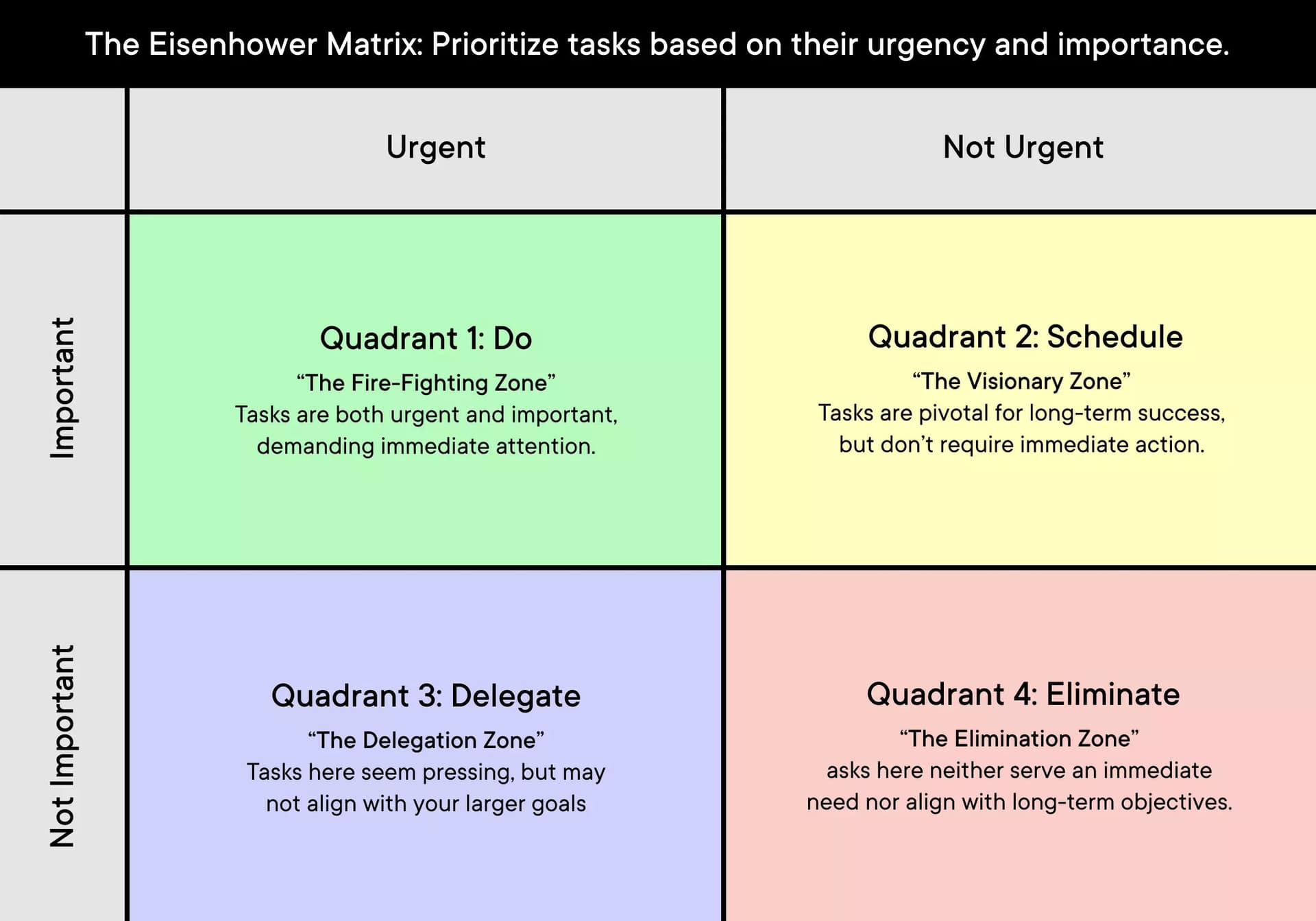
I recommend downloading my free Eisenhower Matrix PDF to help you organize and prioritize for your product and business.
My favorite thing about the matrix is it clears the playing field so that everything isn’t “urgent.” It lets you move forward with what actually moves the needle and avoid getting stuck ticking off boxes that don’t matter.
Automation, delegation, and implementation (oh my)
This is one of my favorite ways to keep product growth going without losing momentum: automation, delegation, and implementation.
These techniques take a company of two or three and make it look like a company of ten.
But before you jump in, review your workflows with a fine-tooth comb. Where are the bottlenecks? What tasks do you repeat every day, month, or year? What are the things that would make you way more productive if you removed them from your plate?
Once you locate those life-sucking workflows, here’s where to start.
Automate repetition away
Anything you find yourself doing more than once, you should automate. For digital product businesses, you could set up a knowledge base to answer your most frequently asked questions. Find software that follows up with customers and asks for a review. Create an email welcome sequence to build a more meaningful relationship between you and your customers.
Delegate for efficiency
There’s working on the business and working in the business. Whenever you find yourself doing the latter, there’s a high likelihood you should delegate that task.
We already know customer support is essential (see the previous section), but it doesn’t mean you need to be in charge of it. Outsource to a trusted organization to log tickets and gather customer feedback so you can focus on longer-term goals. You could also hire a VA to handle mundane tasks like email management, data entry, and managing SOPs. Knowing you’re free of the day-to-day minutiae will clarify where your business is heading and free you up to set goals and milestones.
Implement systems that scale
Even if your product business is small, build with flexibility in mind.
Whether it’s a design system for your product, organizational structuring, or even your first hire (it comes full circle!), make sure you don’t box yourself into a corner with unnecessary rigidity.
Implementing scalability, delegating, and automating are some of the hardest things for most digital business owners (myself included.) I had a tough time letting go of control, but when I did, my business saw more success and reached places I didn’t think possible. Verne Harnish said it best:
“Letting go and trusting others to do things well is one of the more challenging aspects of being a leader of a growing organization.”
Amen, Verne. Amen.
Cultivate accountability
This is a big one. If you don’t build a culture of accountability, it won’t matter how many people you add to the company or how many resources you throw at the problem. You’ll always have issues.
So how do you actually do this without clogging up your progress?
Start by establishing SMART goals. They give everyone on the team a north star. With clear goals, it’s easier for everyone to know what’s expected of them (and even easier for you to hold them accountable.)
Give continuous feedback. Regular feedback creates an open line of communication. When everyone speaks freely and honestly, they build trust, and that creates an environment where people actually want to innovate.
Encourage initiative. When people feel a sense of ownership over their work, they’ll usually have a stronger sense of personal accountability and pride in what they’re creating.
And remember, you can’t ask for accountability if you don’t deliver it yourself. It starts at the top, so lead with it from day one.
Wrapping up
If your product is lucky enough to have momentum, doing anything that might disturb that success can feel daunting.
But from experience, I can tell you that doing nothing and letting the overwhelm of a successful product slowly rip you apart is not the way.
Hire well, prioritize correctly, and automate away tasks and systems that erode your product’s success. When you do, you’ll be able to focus more on what matters: building a better product and a better business.
Good luck!
Matt Downey is a designer who has spent over two decades building digital businesses, now Head of Design at Atlas UP. He writes Digital Native, the newsletter for designers building in the AI era.